


Why 58% of late-stage deals fail, and it’s not about price

Author
Tom Percival
Managing Partner, Basis B2B

Author
Tom Percival
Managing Partner, Basis B2B

Picture this: it’s month 6 of a deal cycle. Your brand has done everything right. You’ve put hard work into building awareness, earned trust in your market, and made it onto the coveted day 1 list.
The sales team is optimistic. The buyer seems genuinely interested. And then… silence. Or worse, a polite email explaining they’ve decided to go in a different direction. This happens constantly across B2B markets. And it reveals something most brands get wrong about the final stretch of a sale.
To understand why, we analysed 7.2 million real B2B buyer conversations using Basis Global’s proprietary data and AI capabilities. Again and again, the same pattern showed up. Late-stage deals rarely fail because of who you are or what you charge. They fail because specific friction points surface when buyers are under the most pressure to get the decision right.
After all, brand equity can get you in the room. But it doesn’t close the deal when a buyer is genuinely worried about whether the transition will work, or whether they can justify a new programme of work to their CFO.
Three pitfalls emerge. Here’s what they are, and how to fix them.
Pitfall 1: Not considering risk from the buyer’s perspective
B2B buyers aren’t just spending budget, they’re staking their own reputation on the decision. A bad call means investment risk for the company and personal risk for the decision-maker. That changes everything about how they evaluate you.
In short, buyers focus on minimising risk rather than gambling on a better result.
That’s why we often see buyers engaging with new suppliers, then defaulting back to their current provider. That’s not because it’s better, but because it feels safer.
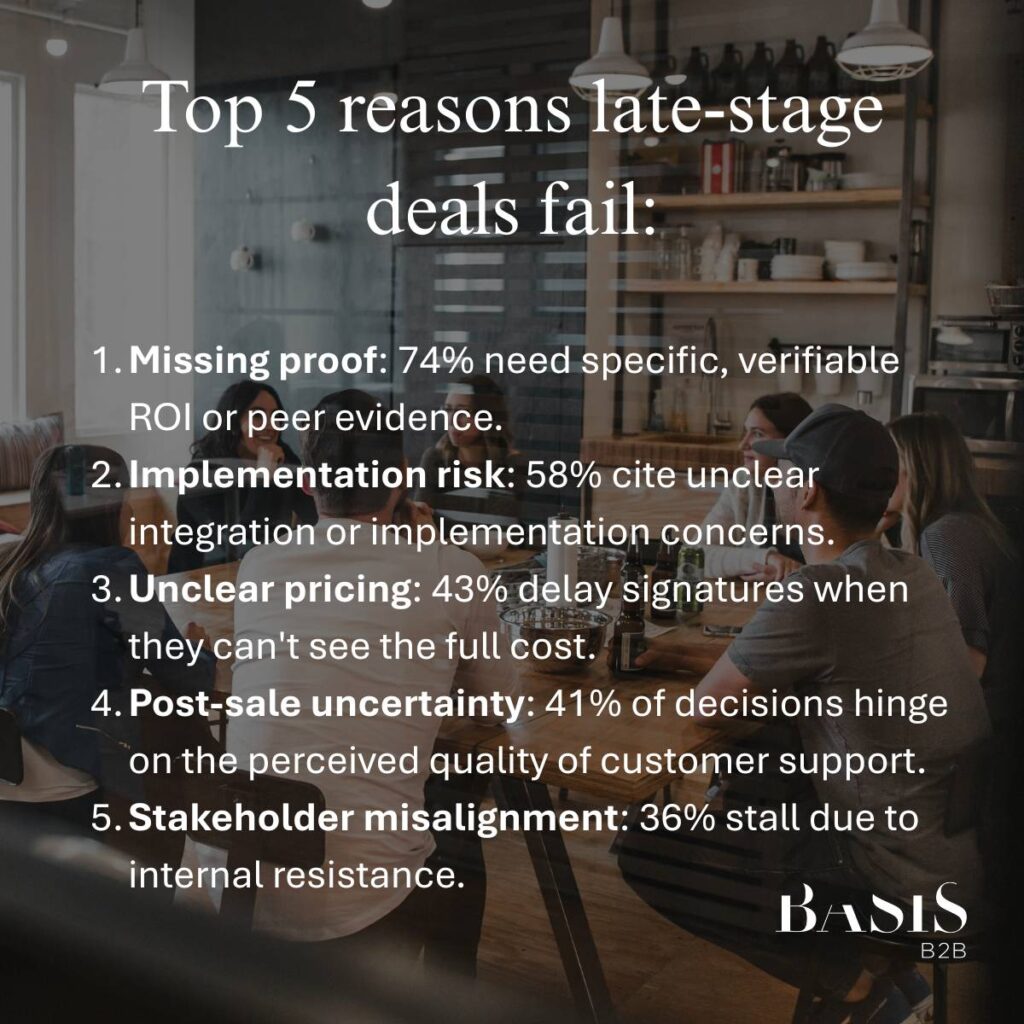
And our data confirms it: 58% of lost late-stage deals cite implementation risk as the primary reason for not choosing a supplier.
How to counter this:
- Build trust by being honest about trade-offs:
Listen to buyers’ needs, not your sales message. Be clear about what you can and can’t do, where compromise is required, and what success depends on. That builds trust and creates the perception you’re on their side, not just closing a deal. - Make proof concrete and defensible:
Requests for case studies and third-party validation add an average of 19 days to sales cycles when they lack concrete examples or named references. Provide them. Case studies and testimonials reassure buyers others have made the move successfully, creating FOMO around commercial benefits. - Sell the transition, not just the solution:
Switching takes time and effort. Don’t just sell the solution, sell the switch. Show them exactly what the first 90 days looks like, who’s going to be working alongside their team, the timeline, and how success will be measured at each stage.
Pitfall 2: Letting indecision drag the deal into limbo
Late-stage deals don’t always fail because someone says no. They fail because not everyone is confident enough to say yes.
The problem is that decision-making units are getting bigger.
Where there used to be three or four people involved, now there are six to ten. Whether it’s procurement, legal, IT, finance, or the end users, each brings different incentives, fears, and definitions of risk.
How to counter this:
- Surface key pain points and play back the answer:
Identify what success and failure look like for each stakeholder, then play those concerns back in concrete terms. Show each person you understand what they’re accountable for, not just what the organisation wants. - Use concrete evidence to create a path to “yes”:
Identify where stakeholders are on the same page, then build on those with specific proof points of success. Every small “yes” matters. IT on implementation speed. Procurement on switching costs. Finance on ROI. Together, they build toward the final decision. - Map the decision ecosystem, not just the org chart: Understand who’s involved, their roles in the buying process, and how they interact. Tailor your messaging accordingly. You’re not selling one story. You’re showing each stakeholder that their concern has been addressed. When people can see personal upside, not just reduced risk, decisions move.
Pitfall 3: Reinforcing the wrong messages
Our analysis found that 74% of successfully landed deals reference seeing success in their peers or a clear proof of ROI. For lost deals, it’s a different picture. Outcome-led language appears in only 30% of lost deals, with buyers being met with buzzwords and claims that don’t stand up to scrutiny.
And it’s not just deals that fail completely. Brands failing to close this ‘proof gap’ have sales cycles that are 21 to 45 days longer on average. That’s Q4 slipping to Q1, and a problem for your targets.
How to counter this:
- Shift from positioning to proof at the final stage:
Where possible, use language that references specific financial and operational benefits. When it comes to the crunch, you should avoid buzzwords like “market leading” or “AI-powered”. They can build brand affinity early on, but late in the journey buyers want detail, not positioning. - Map out what success actually looks like:
ROI is particularly important right now, as most organisations are being asked to do more with less. So every decision maker needs to justify spend, and to do that, they need proof.Overcome this by working with the buyer to establish a clear framework and KPIs up front. Ask: “What does success look like to you?”, “How will you measure it at the end of the project, in six months, in a year?” Then let your proof points answer those questions. Show them the specifics of how similar organisations achieved those metrics.
How this analysis was built
This article is drawn from a much larger body of work.
We analysed 7.2 million real B2B buyer conversations using Basis Global’s proprietary dataset and Organic Intelligence methodology, which combines large-scale AI text analysis with expert human review.
Instead of relying on surveys or stated opinions, this allows us to look at how buyers actually talk when they’re comparing suppliers, sense-checking decisions, and flagging risk, across channels like LinkedIn, peer forums, Slack groups, review sites, and specialist communities.
To find out more, get in touch.
Final word
Most late-stage deals don’t fall apart because the brand promise is wrong. They fall apart because, at the moment it matters most, buyers can’t see that promise showing up in reality.
Early on, positioning does its job. It gets you considered. It gets you shortlisted. It creates belief. But late in the journey, belief isn’t enough. Buyers are thinking about execution. About risk. About what happens if this doesn’t work and their name is on the decision.
That’s where many strong brands stumble. Because they stop translating the promise into what buyers need to feel safe moving forward: clear proof, honest trade-offs, visible delivery plans, and reassurance they can defend internally.
Meanwhile the brands that close deals make it easier to trust the switch. They answer the awkward questions early. They show what success looks like in practice, not just in principle. And they let their brand values show up in how they handle the final stretch, not just how they market the start.
That’s the gap to close. Get that right, and you don’t just win more deals. You build the kind of trust that turns customers into advocates.
That’s where real brand reputation is built. Not in positioning, but in follow-through.
Want to find out more?
Download the full reportHow this analysis was built
This article is drawn from a much larger body of work.
We analysed 7.2 million real B2B buyer conversations using Basis Global’s proprietary dataset and Organic Intelligence methodology, which combines large-scale AI text analysis with expert human review.
Instead of relying on surveys or stated opinions, this allows us to look at how buyers actually talk when they’re comparing suppliers, sense-checking decisions, and flagging risk, across channels like LinkedIn, peer forums, Slack groups, review sites, and specialist communities.
To find out more, get in touch.