

Gen Z research: How young shoppers really choose
This article breaks down the five biggest patterns shaping Gen Z shopping behavior today.
It’s based on Basis Signals, and live behavioral research with young shoppers and is designed for insight, research and marketing teams planning their Gen Z strategy for 2026.
You will find practical guidance for Gen Z consumer insights, brand tracking, segmentation, journey work and AI-led discovery.

We recently ran a live session with a panel of Gen Z shoppers and asked them to show us, in real time, how they decide, discover and dismiss brands. No staging. No slide-led prompting. Just behavior as it happens.
If your team is building a Gen Z research agenda for 2026, this is the layer most brands miss. Below are the five patterns that surfaced again and again, paired with what they mean for research, measurement and commercial strategy.
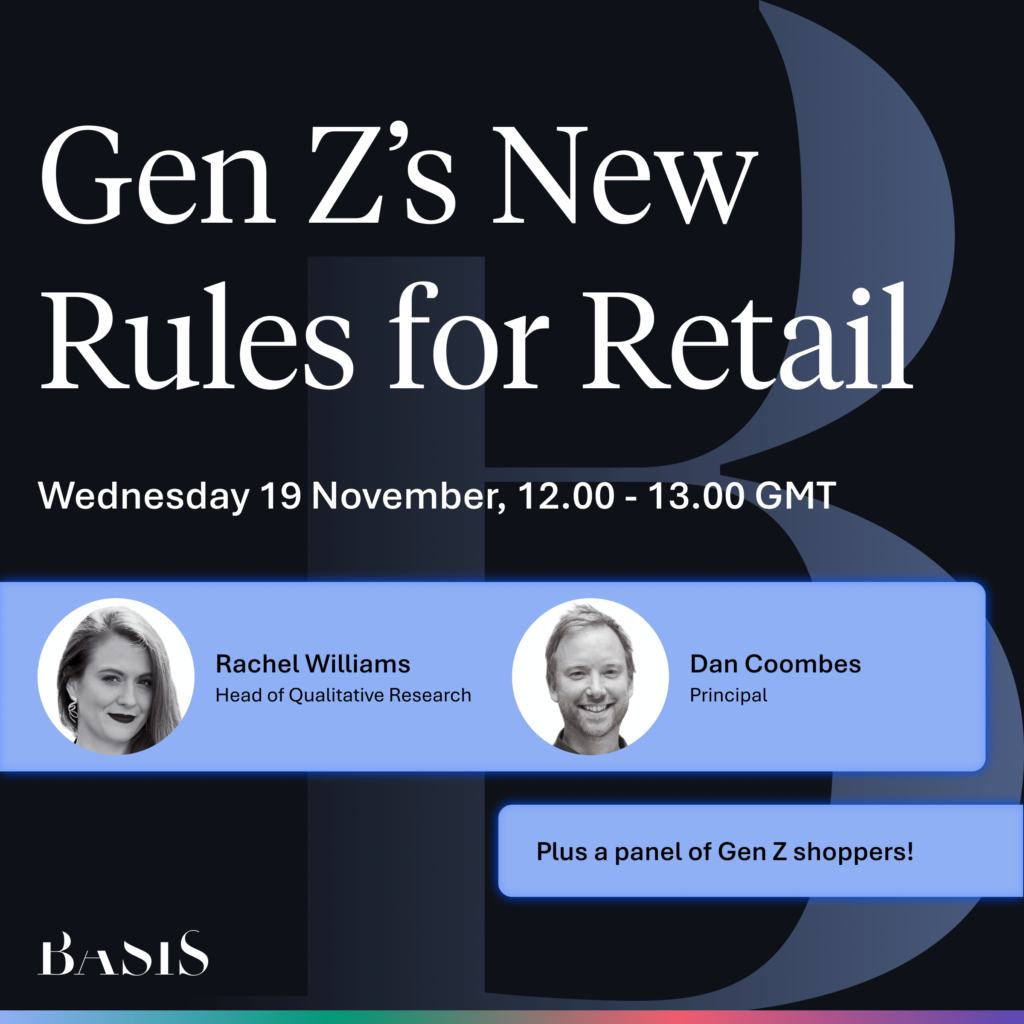
You can watch back the full recording here, or see the key insights below.
1. The rise of the micro upgrade economy
Before the session, we asked panellists what feels worth spending on right now. None of them mentioned big purchases. They talked about micro upgrades.
- A 24 year old strategy advisor, Saarah, described wanting “the little things that bring you joy.”
- Dominion, a 23 year old teacher, admitted that most of his impulsive spending goes toward “food and small treats that make the day nicer.”
- Ankita, a 20 year old student, agreed before calling herself a “Vinted warrior” because the entire experience feels like “a treasure hunt that’s more fun and more me.”
These choices are emotional, frequent and habit forming. They carry more weight in shaping preference than traditional category entry points and they matter for Gen Z consumer insights because they show how loyalty is built through repetition rather than big moments.
What this means for you:
If your Gen Z research focuses only on major shopping missions, you are missing the real drivers of brand memory and repeat behavior. You need Gen Z consumer insights that measure the everyday decisions that accumulate into loyalty.
2. Identity as the deciding filter
Identity was the gravitational center of the conversation. It showed up in details most trackers never capture.
Look at the contrast between stories:
- Ankita talked about creating embroidered jeans with tiny cherries because they felt “uniquely mine.”
- Dominion is a fan of anime. He buys and regularly swaps niche phone cases because “they signal who you are without you having to say anything.”
- Saarah personalises jewelry and handbags with small switches because “it needs to feel like me.”
Identity is not an overlay. It is the decision filter. For Gen Z segmentation and concept testing, this matters because a single rational decision path will not reflect how each individual chooses to express themselves.
What this means for you:
Your segmentation and proposition work must allow for identity-based expression. If your concept tests and pack tests assume a single path, your read of Gen Z relevance will be incomplete.
3. Shared budgets are reshaping the path to purchase
A major shift surfaced here: With 2 in 5 Gen Z moving in with partners earlier than planned to save money, and a growing number extending co-living further by living alongside friends, it’s clear that Gen Z does not shop alone.
- Rebecca, a 20 year old apprentice, explained that her flat “sits down and does our shopping budget together” every week.
- Dominion and his partner moved in together to save on costs. They share out financial responsibilities but make decisions jointly.
While Saraah pointed to the sense of community that comes from shared living. Whether it’s turning an apartment into a cafe for the day, or bringing friends together to do DIY.
The outcome is a longer, more social path to purchase. The researcher, the payer and the user may be different people. This changes how teams should approach Gen Z path to purchase work.
What this means for you:
For Gen Z, you need to model households, not individuals. Journey work and behavioral studies should capture multi person influence, collective decision making and the negotiation moments that shape the basket. This is where most brand trackers fall short.
4. AI is becoming the first storefront
Every panellist used AI in their discovery journey, often as the first step.
- Rebecca spoke about starting with an AI prompt: “Tell me the top 5 mascaras”, before cross-checking on TikTok.
- Saarah turns to AI first because “it learns your style and gives you ideas you did not think to search for.”
- While others discussed using AI to generate meal plans and recipes, curate music choices, or simply answer a passing question.
This is not niche behaviour. It is the first step of Gen Z brand discovery.
What this means for you:
Your brand needs to be discoverable inside AI ecosystems. Brand tracking and path to purchase work must now measure how AI tools influence shortlisting. If you are invisible in generative tools, your funnel is already broken.
5. Nostalgia is functioning as emotional logic
This was the most unexpected pattern. When the panel talked about comfort or connection, nostalgia kept surfacing.
Nostalgia is not a retro brand play for this generation. It is emotional regulation and a driver of choice.
Throughout the session, several panellists spoke about wanting to limit their screen time and reconnect through small, tangible pastimes that feel grounding and safe.
What this means for you:
Map the nostalgic cues in your category. They influence stickiness, brand warmth and perceived safety more than many teams realise.
How to do Gen Z research well
Most brands struggle because they treat Gen Z as a demographic segment rather than a behavioral system. Strong Gen Z research needs five components.
1. Track the moments that actually drive behaviour
Micro upgrades, shared rituals, AI shortlists, identity cues.
2. Build identity into your research design
Allow for expression inside your ideas, stimuli and early concepts.
3. Model households and blended buying journeys
Single decision maker models fail with this generation.
4. Integrate AI discoverability into brand tracking
Ask the real question: Would your brand appear if someone searched your category in ChatGPT?
5. Blend qual depth with quant scale
Gen Z decision making is contextual, emotional and layered. Your measurement system needs to reflect that.
This is the Basis approach. It is why our brand tracking, segmentation, pricing and journey work was referenced throughout the session.

Watch the full session
The full one hour conversation is available to watch. It is the most direct view you will get into how young shoppers actually choose.
Watch back nowLooking for more?
If you want a faster read, the Retail Signals one sheet covers the biggest shifts.
Retail, beauty, gaming and financial services versions are available if you want to see how these patterns land in your category.
And if you are shaping your Gen Z research agenda for 2026, we can help you build the frameworks that actually reflect how this generation chooses.







Gen Z research questions, answered
Gen Z relies on a mix of AI-led search, TikTok reviews, peer recommendations and micro upgrades. AI now plays a major role in early shortlisting, with TikTok used to validate quality and style.
AI is now the first storefront for young shoppers. It shapes the initial list of brands they consider. If your brand does not surface in AI-driven discovery, your funnel starts at a disadvantage.
The micro upgrade economy describes Gen Z’s focus on small, frequent purchases that improve their day. These choices build routine, emotional reward and loyalty and they matter more than big-ticket buying moments.
Identity is the filter Gen Z uses to decide what feels relevant. They look for products that signal who they are, even in small details like colors, textures or personalization options. If your research does not account for identity cues, you will miss the real drivers of appeal.
Find out more
To explore these insights in more depth, watch the full session or get in touch with our team.
Watch back now