


Financial services brand tracking built around trust

Author
Polly Shrager
Managing Partner

Author
Polly Shrager
Managing Partner
Financial services brand tracking has to measure something most trackers treat as a footnote: trust. In a regulated, closely watched category, trust is not one metric among many. It is the primary driver of consideration and the first thing to move when something goes wrong. A tracker that buries it inside a standard funnel misses the signal that matters most.
People do not choose a bank the way they choose anything else. They stay for years out of inertia, barely thinking about it, then leave in a week over one bad experience. That pattern is invisible to a tracker built for categories where people shop around every time.
At Basis, we track financial services brand health around trust, differentiation, and the perceptions that actually drive choice in a crowded regulated market, then hand leadership a clear read on what to do next. We work with banks, lenders, insurers, and payments brands across the UK, US, and beyond, where perception shifts carry real regulatory and commercial consequences.
We built a custom brand tracker for a major US mortgage lender that measured brand health across a range of products, guided creative through a major relaunch, and delivered real-time insights around a marquee national moment over multiple consecutive years.
That program informed strategy associated with a 10 percentage point rise in unaided awareness.
Not sure whether your current tracker is doing its job? Take two minutes and find out.

When financial services brand tracking earns its place
Financial services perception is stable until it is not. A service failure, a data incident, a regulatory story, or a competitor’s move can shift trust quickly, and trust is slow and expensive to rebuild once it drops. Annual waves tell you it moved. They do not tell you in time to respond.
Continuous tracking earns its keep at moments like these:
- Trust is under pressure and leadership needs to see how far it has moved
- A repositioning or rebrand is on the table
- A new entrant is reshaping the category
- A regulatory or reputational event is unfolding and you need to read the perception impact in real time
In financial services, the cost of reading a trust shift late is higher than in almost any other category. The tracker has to stay ahead of it.
What actually moves a financial decision
Awareness rarely explains why someone chose one financial brand over another. The perceptions that move choice in a regulated market look different:
- Trust and credibility: The primary driver of consideration, and the first thing to erode in a crisis
- Perceived stability and security: Which carry particular weight in banking, insurance, and payments
- Perceived fairness: Whether customers believe you treat them well when something goes wrong, which regulators watch and customers remember far longer than a competitive rate
- Differentiation in a crowded field: Financial brands sit close together in a regulated market where products look similar, so perception does the separating
- Consideration and switching intent: The forward-looking measures that predict where share is heading
We design the tracker around the perceptions that predict movement in your part of the category, then compare you to competitors on each, so you know where trust is holding and where a rival is closing the gap.
How Basis tracks financial services brand health
In most categories your competitive set is obvious. In financial services it is wider than it looks. Customers weigh you against the rivals you would expect, but also against whoever is nearest to hand: a challenger app, a supermarket bank, whoever their employer defaulted them into. We build the comparison set around both.
Trust is not one thing either. It splits into competence, fairness, and security, and those three do not move together. A brand can be trusted to keep your money safe and not trusted to treat you fairly when a claim goes wrong. We measure them separately, because the fix for one looks nothing like the fix for the other.
Waves are timed to your rhythm, and an always-on signal layer reads real, unprompted conversation between them, so a shift in trust or sentiment surfaces as it forms rather than a quarter later, when it may already have reached your numbers. This is the ACT framework applied to financial services: Actionable, Customized, and True to what customers actually think.
You can read the full approach on our main brand tracking page.
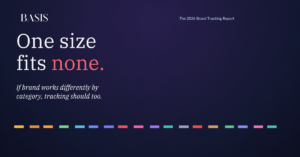
The 2026 Brand Tracking Report
Buying a car and buying a snack are completely different decisions.
Our 2026 Brand Tracking Report shows how buyers actually decide in your category, and why a one-size tracker measures the wrong things. 4,000 buyers, 18 categories, yours included.
Get the report →fits none.
What the outputs look like
The ACTion Brief arrives after every wave. In financial services the questions are usually the same three: has trust actually moved or is this noise, which part of it moved, and how long before it shows up in switching.
What that looks like in practice:
- Where trust sits now, broken down rather than averaged
- Competitive context against the brands customers actually compare you to
- Segment and audience views that explain change rather than just show it
- A clear call on what to protect and what to leave alone
For the underlying measurement approach, see our work on brand health tracking.

The framework
Tracking you can ACT on.
One size fits none, so we don’t sell one. ACT is how Basis builds a tracker from scratch around how your category actually decides.
Actionable
The debrief ends with a decision, not a deck. Every metric has a job. If you can’t act on it, we don’t track it.
Customized
Built around your category and your brand. We use our own research across 18 categories to understand how buying decisions actually work in your space, then design the tracker around those dynamics. Not a standard model applied everywhere. A system built on evidence.
True
Faithful to what customers actually think. Organic Intelligence hears what people say unprompted, so the tracker reflects what’s really moving, not just what the survey thought to ask.
The output, every wave
The ACTion Brief
Every wave ends with one document. Not a dashboard, not a deck. A single call for the quarter, with three plays underneath it and a clear read on what to watch, what to do, and what to skip.
Built around your category. Informed by what buyers are actually saying between waves. Delivered as something leadership can act on the same day they receive it.
Brand Tracking Studies & Resources
Expert insights, best practices, and cutting-edge research to make your brand tracking more actionable and predictive. These resources help you turn data into decisions that drive growth.











See what your financial services tracker is missing
Get a custom financial services brand tracking strategy
Basis B2B
Brand tracking for commercial financial services.
Commercial banking, payments infrastructure, and insurance broking run on different rules. Buying cycles stretch across quarters, decisions sit with committees rather than individuals, and trust is judged on track record and counterparty risk rather than on advertising.
That makes a standard tracker even less useful. You don’t need more data, you need clearer signals from the people who actually sign.
The ACT framework is built to handle that complexity, tracking the perceptions that shape consideration inside target accounts rather than general market awareness.
Financial services brand tracking FAQ
Financial services brand tracking measures how a bank, lender, insurer, or payments brand performs over time across the perceptions that drive choice in a regulated market, with trust at the center. Done well, it connects trust, stability, and differentiation to consideration and commercial outcomes, and explains what is moving and why. Done badly, it reports awareness scores that miss the trust signal that matters most. The value is direction leadership can act on.
Our 2026 Brand Tracking Report covers 4,000 buyers across 18 categories, including financial services, and shows how differently each one actually decides.
Because in a regulated category where products often look similar, trust is what separates brands and drives consideration. It is also the first thing to move when a service failure, data incident, or regulatory story hits, and it is slow and costly to rebuild once lost. Basis treats trust as a primary measure rather than one line in a standard funnel, and tracks the specific components of it that predict consideration and switching in your part of the market.
Regulation shapes both what you can say and how customers judge you, so a financial services tracker has to reflect that reality rather than apply a generic model. Perceptions of compliance, stability, and fair treatment carry real weight, and reputational events can move them fast. Basis designs financial services trackers around this sensitivity, tracking the perceptions that matter in a regulated market and flagging shifts early, so leadership can respond before a change reaches the numbers.
Your obvious rivals, and usually a few less obvious ones too. A high street bank still needs to know where it stands against the other high street banks. But consideration also leaks toward whoever is nearest to hand: a challenger app, a supermarket bank, the provider someone’s employer defaulted them into. Basis builds the comparison set around both, so you see the competitive picture as customers experience it, not only as the category defines it.
Most financial brands benefit from continuous or frequent tracking, because trust is stable until an event moves it quickly, and reading that shift late is costly. A service failure or regulatory story can change perception faster than a quarterly wave can capture. Basis times waves to your business and adds an always-on signal layer between them, so a change in trust or sentiment surfaces early, while there is still time to protect the brand and respond.
Stop reporting. Start protecting trust.
Most financial services tracking delivers charts. Ours delivers decisions you can act on before a trust shift reaches your numbers.
Talk to our financial services team