


The Value Proposition Canvas
How to put the customer at the heart of your strategy


Author
Conor Wilcock
Managing Partner, B2B

Author
Conor Wilcock
Managing Partner, B2B
The challenge of achieving meaningful differentiation
Of all the things that are difficult about B2B marketing (and there are quite a few) perhaps the most difficult is achieving meaningful differentiation. There are two parts to this of course: it’s not enough to simply stand out from the crowd; you need to do so in a way that is compelling to the customer. Although I’m not a great believer in the whole “any publicity is good publicity” mantra, I do subscribe to the view that indifference is the real killer of brands.
So, why is it so difficult? After all, it’s quite easy to think about things your company is good at. And we all keep a fairly close eye on what our competitors are doing, right? Why can’t we just articulate how what we do is better than everyone else?
Your strengths and your competitors are two legs of the stool. The third, though, is the most important one, as it’s the one that keeps it from collapsing! Unfortunately, it’s also the most overlooked. This is the customer: who are they, what do they need and what do they want?
After all, “you can’t read the label from inside the bottle.” (citation: every marketer at every conference between 2014-present — original probably Mark Twain).
What’s more is that we tend to overestimate just how good we are at things and just how bad competitors are. B2B marketing definitely suffers from a sort of blind exceptionalism that is very damaging and creates a “sea of sameness” in which customers feel continually underserved and lacking real choice. This is a big reason why more than 70% of new B2B product or service launches fail.[1]
It’s not about picking just one either. All three need to be considered to create a truly effective value proposition. But the order really, really matters. And this is where the Value Proposition Canvas comes in.
What is the Value Proposition Canvas?
The Value Proposition Canvas is a framework developed by Dr. Alex Osterwalder and the Strategyzer team as a companion to the Business Model Canvas. In their words, it “helps you design products and services that customers really want.”[2]
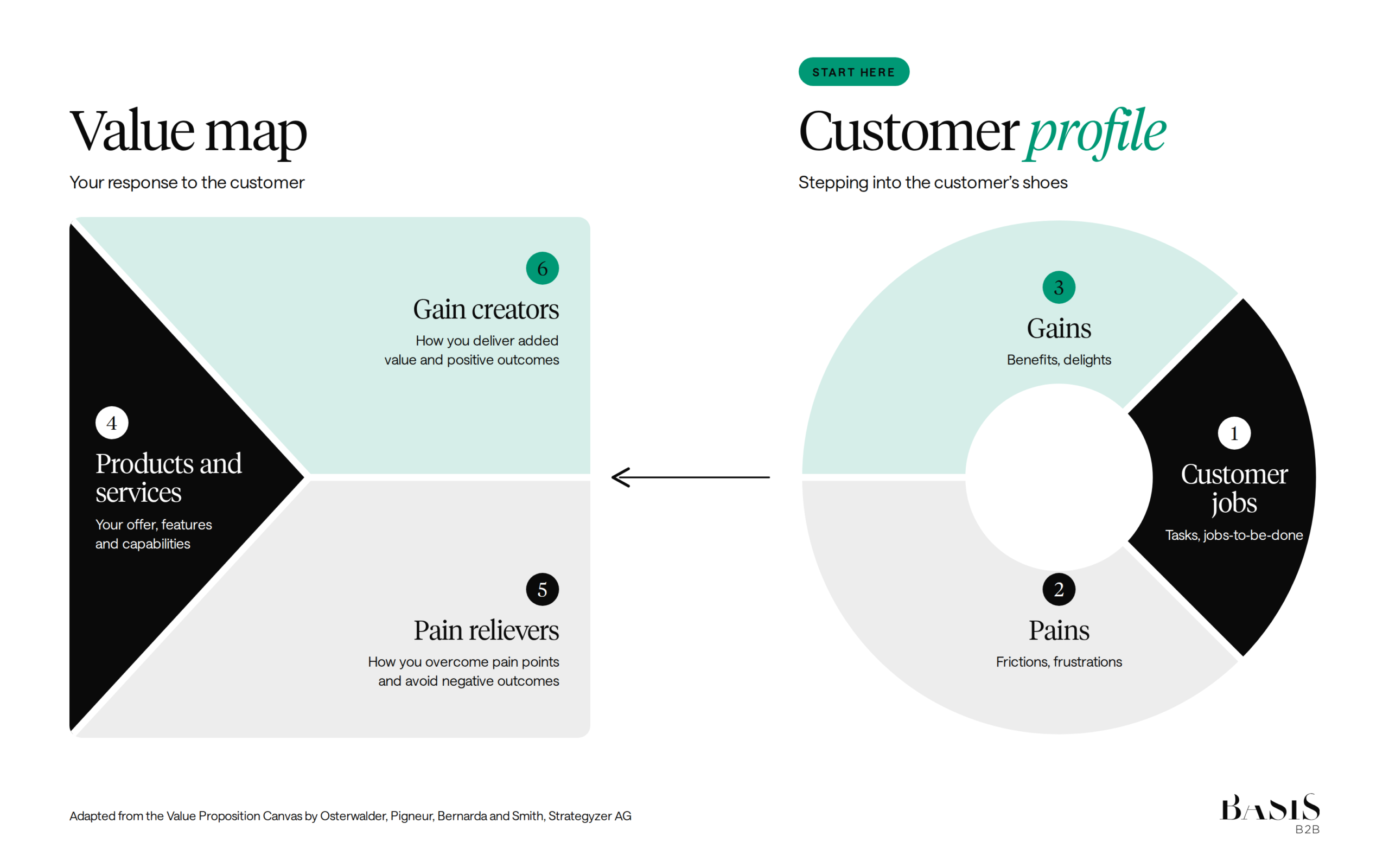
Like all successful marketing and strategy frameworks, it’s simple and easy to use. The Canvas has two main parts: The Customer Profile and the Value Map. The Customer Profile is always done first:
Customer Profile: this is when we need to step into the customers’ shoes. Use insight and customer voices where possible to avoid speculation or internal assumptions:
- Customer jobs: the tasks (jobs-to-be-done) that customers are trying to conduct. These can be functional, social or emotional. It’s a “day in the life” description
- Pains: the things that prevent the customer from getting the job done. These are frictions, obstacles, and negative outcomes and experiences the customer hopes to avoid
- Gains: how a customer would articulate a job well-done. These are benefits, positive outcomes and experiences, and things that would delight the customer
Value Map: this is your response to the customer and everything you know about them: their jobs, pains and gains. It’s not just a list of products and services (though the “what” here is important); it’s also about messaging, benefits and driving value.
- Products and services: what you can offer to the customer that helps them, with a focus on key features and capabilities that deliver value
- Pain relievers: how these specific products and services help customers to overcome pain points, remove friction, make their job easier and avoid negative outcomes
- Gain creators: how these specific products and services benefit and delight the customer, helping them to achieve goals and positive outcomes
Why is it so effective?
The power of the Value Proposition Canvas is that it forces you to think about the customer first. There’s no way around it once you’ve decided to use the framework. By thinking about the value map as a response rather than a lead-in, you put the customer at the centre of your brand’s solution and positioning: who they are, what they do, why they do it and how you can help them.
Another benefit of the Canvas is that it tends to encourage leanness when teams use it. Simplicity and clarity are the holy grail of value propositions, and the framework enables brands to “trim the fat.” Avoid the temptation to talk about everything because guess what? The customer doesn’t care, they’ll get confused and you’re not that good at it all anyway!
Thirdly, when used properly, the Value Proposition Canvas close-to-guarantees that you will use buyer language, not brand language in your marketing and messaging. We know how important this is and yet how poorly B2B brands currently perform; Basis’s recent research found a huge gap between the language used by brands and the language used by buyers. Marketers who use the Canvas are better able to articulate solutions, benefits and differentiation in ways that resonate with the customer, precisely because the proposition’s foundation is the customer themselves. No more hype language; no more corporate-speak.
When should I use it?
The original intended use-case for the Value Proposition Canvas was companies conducting product-market-fit exercises, and though it’s certainly useful in that situation, I’ve found it to be much more versatile.
Think of it as good discipline whenever you are creating something that goes to market. This could be what you sell (product and service development, solutioning, bundling) or how you sell it (marketing, messaging, creative, positioning):
- Big, strategic proposition-building
- Ideation, concept creation, pre-launch testing
- Messaging refreshes
- Segmentation-related strategy (how do we serve different segments in different ways)
- Diagnosis of pipeline conversion problems
- Proof and claims development
- Internal sales and marketing alignment
As always, the effectiveness of a framework like the Value Proposition Canvas depends on the quality of the insight going in (especially on the customer side), buy-in from the people using it, and the commitment to using it in the right way. Get it right though, and you’ll find your brand cutting through the noise and delivering real, lasting value to customers.
Great propositions start with knowing your customer. That’s what we do.
Talk to our B2B team[1] Simon Kucher + Partners
[2] Dr. Alex Osterwalder and Strategyzer: Value Proposition Best Practices webinar