Webinar recap: What are we not asking?
What 70,000 online conversations taught us about getting brand tracking right.
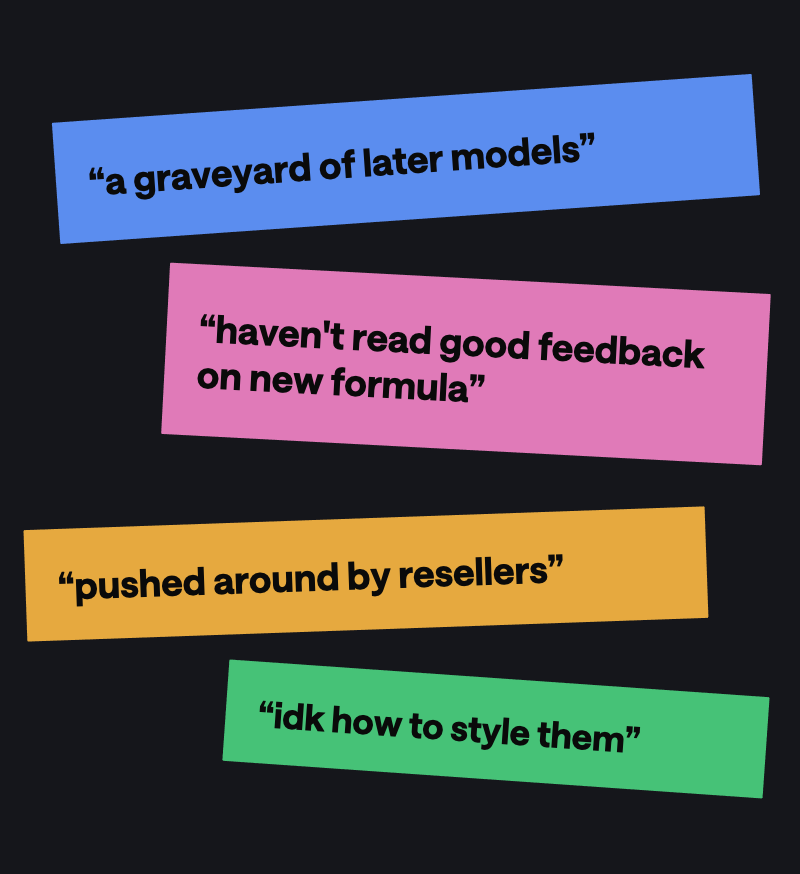
Chris Hope, who leads some of our biggest client relationships (including brand tracking), and Lindsey Dietz, Director of our social and digital practice, recently ran a webinar on why brand trackers so often fail to change a decision, and what to do about it.
Chris comes at tracking from the survey side and how to design it, Lindsey from what people say about brands when nobody’s asking, which is often where the explanation for a moving score sits.
Brand tracking is expensive, so it should earn its keep.
Here’s how to build trackers that tell you what to do next.

Missed it live? Watch it on demand.
Watch back now
What’s covered in the session
The session ran in two halves. First, what our research says about how people buy and what that means for what you track. Then, what 70,000 online conversations add to the scores. Here are the three big points from each.
Three big takeaways from the tracking research
-
How people buy changes what you should track
We pick potato chips without thinking long before we shop. Not so with cars. Our One Size Fits None study asked 4,000 people in the UK and US how they buy across 18 categories. It shows loud and clear that how people buy changes what you should track. - Not every perception matters in every category
Some perceptions matter everywhere: trust played a role in choice in every category we studied. Others only earn a place in some. What a brand stands for mattered to 52% of car buyers and 38% of chip buyers. Tracking them isn’t enough on its own, though. Trust is an outcome of what a brand does: broadband might earn it by fixing problems the first time, a credit card by preventing fraud. If you don’t know how a perception is built in your category, the score can’t tell you what to fix.
- Claimed loyalty can be misleading
Most people say the brand they bought is one they usually or always buy. But the categories with the highest claimed loyalty, like laundry, soft drinks and chips, are also where people are most likely to switch if a cheaper brand appears. So track vulnerability, not just claimed loyalty.
Three big takeaways from 70,000 conversations
Scores tell you what moved. To find out why, our Organic Intelligence team read 70,000 online conversations about six brands to see what that adds to a tracker: what a score really means, where to look when it moves, and what it might be missing.
Here’s what stood out:
Estée Lauder’s fans are hunting a foundation that no longer exists
A loyalty score can’t tell you whether people are loyal to the brand or to one formula.

Sony’s quality problem may be a hinge
When owners define quality in their own words, it looks very different from a single score.

Wayfair’s quality score may be measuring two problems at once
Furniture quality and delivery reliability need separate fixes, and probably different teams.

Across all three brands, the conversations showed what people had in mind when they talked about loyalty or quality. Those details give us more specific questions to ask in a tracker.
Social listening starts with keywords.
Organic Intelligence starts with your business question.
We start with the question, build a dataset around where people talk about it, then group the conversation into themes. Every theme stays tied to the real posts, so you can see how people put things.
In the Q&A, Lindsey takes on the obvious question: how is this different from social listening, and does it hold up across markets?
Three questions to put to your own tracker:
- Do your metrics reflect how people buy in your category?
- Do you know how the perceptions you track form among your consumers?
- Are you confident you’re measuring the right things?
If any of those gave you pause, we’d love to talk. We have data for all 18 categories in the study and we’re happy to share it.