

The B2B brand problem hiding in Gen Z conversations
The Gen Z Brand Radar isn’t designed as a B2B ranking, and it doesn’t need to be.
It tracks how Gen Z talks about brands across six types of conversation, from credibility and advocacy to self-expression and participation. The brands that show up most strongly tend to be in fashion, beauty, sportswear, and tech.
That in itself isn’t especially surprising. What matters more is what those conversations reveal about how Gen Z forms opinions, assigns credibility, and decides what matters.
Because that same mindset is already shaping how buying decisions get made in B2B.

Gen Z is already in the room
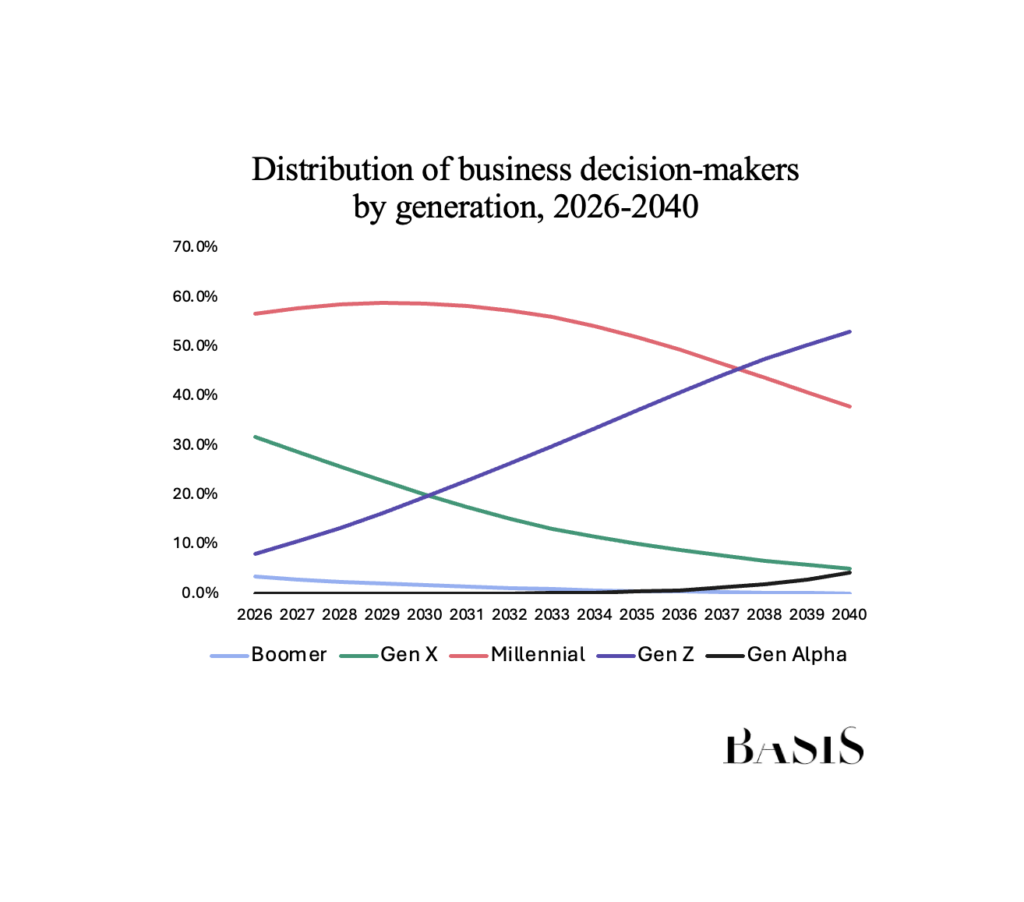
As things stand, Gen Z accounts for around 8% of influence in B2B buying decisions. That share is expected to double within the next three years. By 2031, there will be more Gen Z decision-makers in businesses than Gen X, and in just over a decade they will overtake Millennials as the main decision-making group.
Even now, that shift is starting to show in how decisions take shape.
They are already researching suppliers and shaping shortlists, often influencing decisions before more senior stakeholders get involved.
They also behave differently from the buyers B2B brands were built to reach. Gen Z engages with B2B creator content 11% more than other generations, while almost 9 in 10 prefer content from peers and trusted industry voices over brand channels.
Their opinions are formed early, through networks, communities, and shared content, often outside the places most B2B brands focus on.
The number that should make you nervous
As Gen Z’s influence grows, more of the decision is being shaped before any formal buying process begins.
Our latest report, What B2B buyers say about you when you’re not in the room, built from 7.2 million real buyer conversations across LinkedIn, Slack, specialist forums, and peer communities, found that 83% of what buyers say about a brand contradicts how that brand describes itself. Between 70% and 80% of negative sentiment appears before any formal RFP exists.
By the time a prospect raises their hand, the narrative around your brand is already in circulation.
The buying process tends to reinforce that narrative rather than reshape it. When a sales conversation begins, it is entering a discussion that has often been developing for weeks or months.
What matters is whether your brand has shaped that opinion before you enter the room.
What the Gen Z Brand Radar actually shows
For B2B, the value of the Brand Radar is not the ranking itself. It’s the structure underneath it.
Across six distinct types of conversation, it shows how brand perception is built over time, through a mix of credibility, urgency, participation, and advocacy.
Those same dynamics exist in B2B. They just play out differently.
| Gen Z conversation type | What it looks like in B2B |
|---|---|
| The Verdict Is this brand credible? |
Proof of ROI, detailed case studies, public reviews, live demos, independent validation such as accreditations or industry awards |
| The Drop Is this brand culturally urgent? |
Product innovation announcements, early access programs, waitlists, first-mover positioning, “we built this because you asked” moments |
| The Edit Is this brand worth keeping? |
Ongoing customer success management, deep workflow integration, switching costs that feel like an investment, genuinely useful onboarding, customer-first advice and content |
| The Remix Does this brand enable self-expression? |
Open APIs, partner ecosystems, customization, brands whose product becomes a platform others build on such as Salesforce, Slack, HubSpot |
| The Crowd Would Gen Z recommend it? |
Peer reference calls, Slack community advocacy, Reddit and LinkedIn threads, the “ask your network” moment before shortlisting |
| The Moment Is this brand worth showing up for? |
Conferences, product launches, user summits, events people genuinely want to attend rather than feel obliged to |
Take advocacy as an example. In consumer spaces, that might show up through social sharing or influencer content. In B2B, it appears through peer reference calls, community discussions across Slack groups, forums or Discords, LinkedIn and Reddit threads, and the “ask your network” moment that happens before a shortlist is finalised.
Different channels, but the behaviour is the same
The shift most B2B brands are missing
Most B2B marketing is still built around the point of purchase, with a heavy focus on capturing demand once a buyer is actively in market.
But as we’ve explored, more of the decision is now shaped earlier, across a wider set of touchpoints that sit outside the formal buying journey.
By the time buyers are evaluating suppliers, much of their perception is already in place. The buying process tends to reinforce those views rather than change them.
For brands investing heavily in the 5% of buyers who are actively in market, a growing share of influence is being shaped in the 95% of time when buyers are not.

The B2B self-check
Most B2B organizations have never mapped their brand presence this way. But it’s a useful question to sit with.
- Where do you actually show up in buyer conversations?
- Are you visible in proof and credibility but absent from peer recommendation?
- Do you generate moments at industry events, but struggle to translate them into ongoing advocacy?
- Is there a community that champions you, or do buyers use you without ever talking about you?
That last distinction matters more than most brands realize. Our buyer data shows a 14% overlap between the phrases brands use most and the language buyers actually repeat when making decisions. Buyers want specifics, track records, things they can sanity-check with a peer. Most brands are still answering a different question entirely.
The disconnect isn’t just a messaging problem. It’s often a lack of presence. And it’s hardest to spot precisely because it’s happening in conversations you’re not part of.
The question worth asking
Gen Z is not bringing a completely new set of behaviors into B2B. They’re accelerating and amplifying patterns that are already impacting your bottom line.
The question for B2B isn’t whether you can replicate consumer brand culture. It’s whether you understand where the conversations shaping buyer perception are already happening, and whether you’re present in them when it counts.
Where do you show up? Where are you absent? And what’s being said when you’re not in the room?
Curious where your brand sits in B2B buyer conversations?
We run perception diagnostics that show you exactly what the room is saying when you’re not in it.
Get in touchExplore our Gen Z research series






How we conducted this Gen Z research
The Gen Z Brand Radar uses our Organic Intelligence methodology, which combines:
- Built for this study. Over 50 million organic signals from unprompted public conversation across TikTok, Instagram, Reddit and Discord. What Gen Z says when no one’s asking.
- Custom AI models. Brands scored on a composite of conversation volume, sentiment and momentum within each conversation type. Ranked by Strength (average percentile score, weighted 60%) and Breadth (number of conversation types a brand appears in, weighted 40%).
- Human insight consultancy. Our team interprets the patterns and translates them into strategic recommendations.
This approach surfaces signals traditional research misses. Social listening requires knowing what to look for. Surveys capture responses to your questions, not organic behavior. Our Gen Z research captures what’s actually happening.